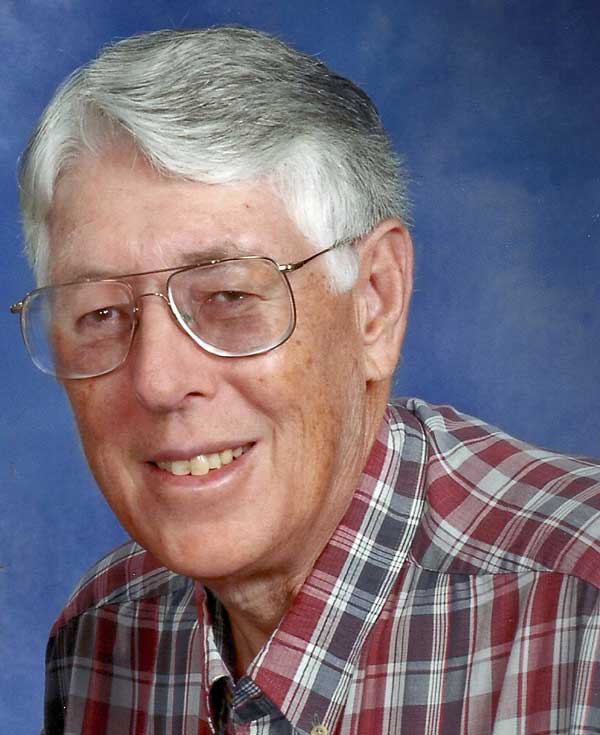
Kenneth Ray
Houston
Region 6 RVP 1992-93
June 5, 1947 - Living
 I
was born and raised in Carlsbad, New Mexico. My parents were Kenneth Nevar
Houston and Wanda Irene (Whitaker) Houston. Dad always signed his name as
Kenneth N. Houston due to people mispronouncing his middle name as
"Never." His youngest brother, Jack, complained that he was not given
a middle name. His brothers, including my Dad, told him he was lucky, as they
all had strange middle names.
I
was born and raised in Carlsbad, New Mexico. My parents were Kenneth Nevar
Houston and Wanda Irene (Whitaker) Houston. Dad always signed his name as
Kenneth N. Houston due to people mispronouncing his middle name as
"Never." His youngest brother, Jack, complained that he was not given
a middle name. His brothers, including my Dad, told him he was lucky, as they
all had strange middle names.
I am a
fifth cousin of General Sam Houston, many times removed. My grandfather and great grandfather were
both named Sam Houston. At the height of 6' 8" I am the tallest person in
my entire family as far back as anyone knows. When I moved to Texas from New
Mexico, I started looking for those so called "tall Texans" only to
find that in most circles I am "the tall Texan."
At an early age I learned to appreciate nature,
having been born it seems with a natural curiosity concerning living things.
Many times as a small child I would come into the house with a different insect
in my hands. My mother even encouraged my curiosity. I read everything I could
find concerning insects, animals, and plants. I even had a black widow spider
for a pet for a while.
After graduation from high school, I attended
college at the New Mexico Institute of Mining and Technology (better known as
the New Mexico School of Mines) at Socorro, New Mexico, where I received my B.S.
degree in Chemistry in June, 1969.
I worked for three years as a Quality Control
Supervisor in Sweetwater, Texas, at
the U.S. Gypsum Company Quality Control Lab. The lab tested Sheetrock®
wallboard,
plasters, and agricultural gypsum. In June 1972, I began working for Dow
Chemical Company in Freeport, Texas. I worked as a Mass Spectroscopist for 10 years in Dow's Analytical Sciences
Department. The shows you see on TV like CSI where samples
are injected and a few minutes later they have the answer are mostly fictional.
Most of the time it took several days to a week to determine the composition of
the chemicals I tested at Dow.
Around 1980, I realized the importance of
computers to my job at Dow and purchased my first personal computer which was a
Radio Shack Tandy 1000. This computer was equipped with 2 floppy drives, no hard
drive, and 256 kb of RAM. The computer cost me $3500. I had to learn everything I
could about DOS and I did that by reading the book and playing with the
computer. I still occasionally find that DOS comes in handy. Today's computers
are so much more powerful and much cheaper, too. I have never taken a computer
course, but have learned everything I know about computers and software by
digging into them.
After I joined Analytical Sciences, because of my interest in computing, I was
asked to take over administration of a local Novell Network which was set up for
the Mass Spectrometry, Nuclear Magnetic Resonance (NMR), and Infrared groups. When Dow
decided to standardize their desktop PCs in 1996, I was asked to take over that project for Freeport
Analytical Sciences. Because of my extensive experience with networking and PCs
and the poor quality of support from Dow's Help Desk, I became the "help
desk" for Freeport Analytical Sciences for about 2 years. In 1997, I began
designing and maintaining web pages for Global Analytical Sciences. That site
was comprised of over 2000 web pages. I retired from Dow Chemical as a Senior
Research Technologist on July 31, 2004, after working 32 years for Dow.
While single, I purchased my house on two acres of
land in Lake Jackson, Texas. Two years later I met Mary McDaniel and we married
November 24, 1979. Previous occupants of the house had planted Hemerocallis
'Kwanso' in several locations around the property. I was particularly
impressed with this daylily growing in one row 4' wide and 50' long. The only
care I gave it was to mow it twice a year. That daylily just kept growing and
blooming. I even dug some of it up and left it laying on the concrete driveway
for a couple of weeks. It tried to grow on the driveway.
One November Sunday in 1984, I saw a notice in
the local paper about a daylily auction to be held by the Brazosport Daylily Society.
I convinced Mary we should check this out. I was really impressed with the
variety of daylily colors and forms, having only knowledge of H. 'Kwanso'.
That Sunday I spent $60 for auction plants and joined the club and the American Hemerocallis
Society, much to Mary's
dismay. She could not believe I had spent that much money on some dead looking
plants! If I wanted to go to those club meetings I could, but she was not going
to waste her Sunday afternoon nap time with such foolishness. It wasn't long
until she got the daylily bug, too.
Having somewhat of an analytical mind, I started
keeping records for each of the cultivars we have collected. At first this was
done in a notebook and later transferred to my computer. I religiously keep
track of the first bloom date and rebloom date for each cultivar we grow.
I served as 1986 President of the Brazosport Daylily Society, and held several other club offices. Both Mary and I became American Hemerocallis
Society Senior
Exhibition Judges under the prompting of Bertie
Ferris. It was almost impossible
to say "No" to Bertie. We really enjoyed judging daylily flower shows
and did so every chance we got, until I started having major medical problems.
I served as 1992-93 Region 6 RVP and Newsletter
Editor. I was the first Region 6 Editor to use a computer to create
the newsletters. Previous Editors used true cut and paste, with scissors and
glue. I also served as the 2000-01 Newsletter Editor when Jean Consford
served as RVP.
I was a member of the American Hemerocallis Society
(AHS) team that updated the
1997 and 2002 Judging Daylily Handbooks.
In 2001, Mary and I were honored to be the
recipients of the AHS Region 6 Service
Award. That same year I began serving as the Region
6 Webmaster and continue to serve in that capacity. In 2002, I became the Region
6 Archivist/Historian. As Region 6 Archivist I have all of the hard copy Region 6
Newsletters since 1961. In 2005, I began a project to scan all of the newsletters and
create searchable documents in Microsoft Word and Adobe Acrobat format. I
finished scanning the newsletters in July 2008. I have ready access to over 195
digital copies of the Region 6 Newsletters and am able to perform electronic
searches for any string of text in a matter of minutes. Using my position as
Archivist/Historian, I have added much historical information to the Region 6
website.
In January 2011, I began serving as the AHS Region 6 Group Leader for the newly created AHS Membership Portal.
From December 2011 through December 2019, I
served as a member of the AHS Archives & History Committee and worked with a team; led by Ken Cobb,
AHS Archivist/Historian; to create historical documents concerning people who have
made significant hybridizing and/or leadership contributions to the Society. We also
worked on digitizing the AHS Daylily Journals dated 1946-2008. That project
was completed in 2015 and the electronic versions of the Journal
are now available on the AHS Membership Portal.
On July 12, 2025, at the American Daylily Society
National Convention in Seattle, WA, the 2025 AHS Electronics Media Award was
presented for my work since 2001 creating and maintaining the Region 6 website.
An article about the website and award was published in the Fall 2025 issue of
the Daylily Journal. I placed the Electronics Media Award logo on the
Region 6 website home page.
Webmaster: Ray
Houston
Revised: 09/30/2025
Menu by Milonic Solutions